The modern agricultural landscape demands more than just raw power from machinery; it requires a profound focus on operator health and productivity. A high-quality tractor suspension seat is no longer a luxury but a critical necessity for farmers and operators who spend ten to twelve hours a day in the field. By mitigating the harsh vibrations and shocks transmitted from the chassis to the spine, these advanced seating systems ensure that productivity remains high while long-term health risks are minimized.
Globally, the shift toward precision farming has highlighted the importance of the human-machine interface. When an operator is fatigued by constant jarring movements, their decision-making speed drops and the risk of operational errors increases. Implementing a sophisticated tractor suspension seat directly addresses this physiological strain, transforming the cockpit into a sustainable workspace that promotes endurance and safety.
Understanding the mechanics and benefits of suspension systems allows fleet managers and individual owners to make informed investments. Whether dealing with the rugged terrains of Southeast Asian rice paddies or the vast plains of North America, the right seating solution prevents chronic lower back pain and musculoskeletal disorders. This guide explores the technical evolution, practical applications, and future trends of these essential components in the agricultural industry.
Global Relevance of Ergonomic Seating
On a global scale, the agricultural sector is facing a dual challenge: an increasing demand for food production and a declining workforce due to the physical tolls of farming. ISO 2631 standards emphasize the danger of whole-body vibration (WBV), which is prevalent in tractor operation. Without a high-performance tractor suspension seat, operators are exposed to constant mechanical shocks that can lead to permanent spinal disc degeneration.
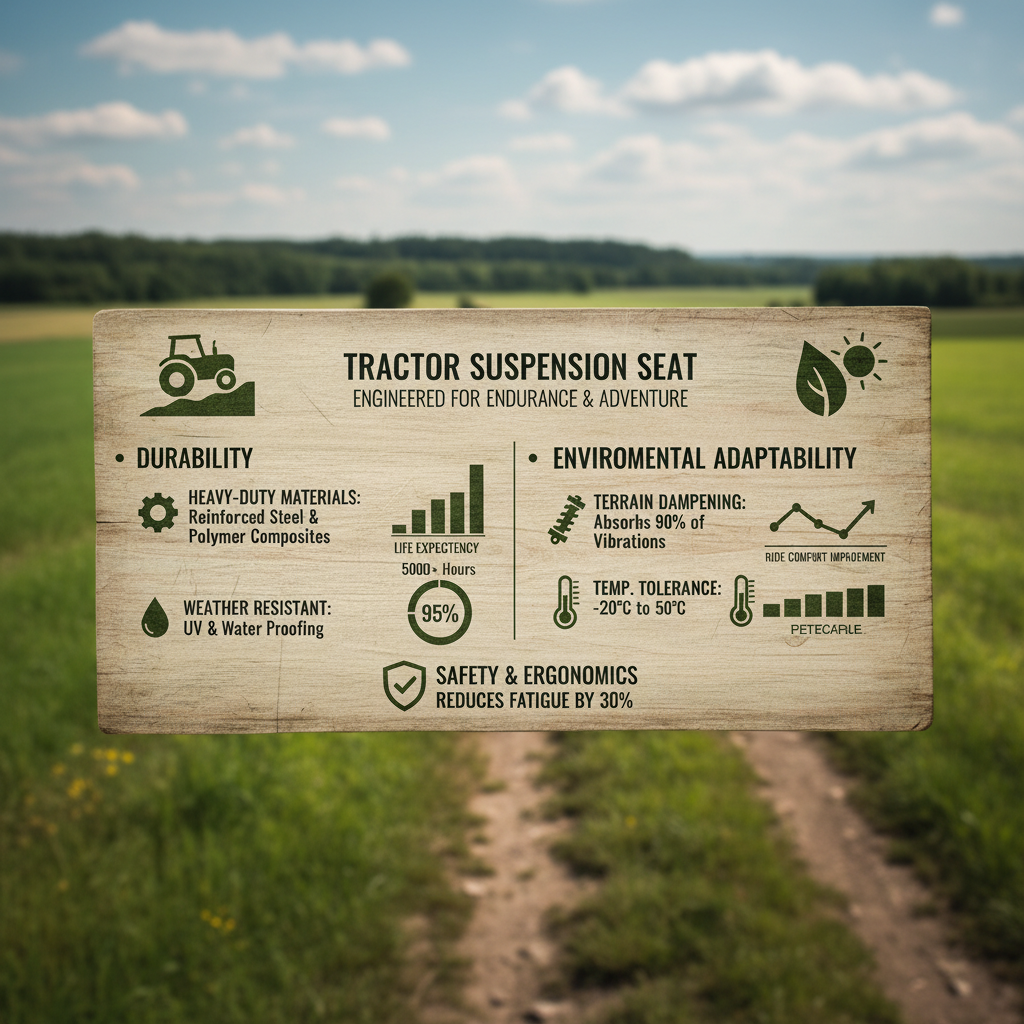
Statistics indicate that ergonomic interventions in the cockpit can reduce operator fatigue by up to 30%, leading to a significant increase in daily hectares covered. By integrating advanced damping technologies, manufacturers are now aligning tractor cabins with modern occupational health standards, ensuring that the backbone of the global food supply—the farmer—is protected from occupational injuries.
Defining the Tractor Suspension Seat
A tractor suspension seat is a specialized mechanical assembly designed to decouple the operator from the vibration and impact of the vehicle's chassis. Unlike a standard fixed seat, a suspension seat utilizes a combination of springs, dampers, and often pneumatic cylinders to absorb energy from uneven terrain. It acts as a primary shock absorber for the human body, converting vertical kinetic energy into controlled motion.
In the context of modern industry, these seats represent the intersection of mechanical engineering and human physiology. They are engineered to handle varying operator weights and different frequency ranges of vibration, ensuring that the damping effect is consistent whether the tractor is idling or traversing a rocky hillside. This customization is key to preventing the "bouncing" effect that can occur with poorly tuned systems.
Beyond simple comfort, these seats are humanitarian tools. In developing regions where roads are poor and machinery is often aged, a retrofitted suspension system can extend the working life of a farmer by preventing debilitating back injuries. It turns a grueling physical ordeal into a manageable professional task, directly impacting the quality of life for millions of agricultural workers worldwide.
Core Components of Suspension Systems
The effectiveness of a tractor suspension seat depends on its internal architecture. The primary component is the suspension mechanism—typically either mechanical (spring-based) or pneumatic (air-based). Mechanical systems offer rugged reliability and low maintenance, while pneumatic systems provide superior adjustability and a "smoother" ride by allowing the operator to tune the air pressure to their specific body weight.
Another critical element is the shock absorber or damper, which prevents the seat from oscillating uncontrollably after a bump. Without a high-quality damper, a tractor suspension seat would behave like a pogo stick, potentially increasing the risk of injury. Modern dampers use hydraulic oil or specialized polymers to dissipate energy quickly and efficiently.
Finally, the seat cushion and frame play a vital role in load distribution. High-density foam with memory properties ensures that pressure is distributed evenly across the thighs and buttocks, preventing "hot spots" and circulatory restriction. When these components—suspension, damping, and cushioning—work in harmony, the result is a seating system that preserves the operator's energy and focus throughout the workday.
Performance Factors and Efficiency
Evaluating a tractor suspension seat requires looking at more than just "softness." True efficiency is measured by the transmission ratio—the amount of vibration that reaches the operator versus what is absorbed by the seat. High-efficiency seats target the 1-10 Hz range, which is the most damaging frequency for the human spine.
Durability is equally important. Since these components are exposed to dust, moisture, and extreme temperature fluctuations, the materials used must be corrosion-resistant and wear-resistant. A seat that loses its damping capability after one season is a liability, not an asset. Therefore, the use of reinforced steel and industrial-grade polymers is standard for premium suspension solutions.
Comparative Efficiency of Tractor Suspension Seat Types
Real-World Applications and Use Cases
In large-scale industrial farming, such as the wheat belts of Canada or Australia, the tractor suspension seat is used to maintain operator alertness during 24-hour harvest cycles. In these high-pressure environments, the ability to adjust the seat height and tilt dynamically allows the operator to maintain a clear line of sight while minimizing physical strain.
Conversely, in remote industrial zones or post-disaster relief operations where tractors are used for debris clearance, the ruggedness of the suspension system is paramount. In these contexts, seats must withstand extreme shocks without failing, ensuring that critical infrastructure recovery can continue without the operator becoming incapacitated by fatigue or injury.
Long-Term Value and Operator Health
The long-term value of investing in a premium tractor suspension seat is measured in reduced healthcare costs and increased career longevity. Chronic lower back pain is one of the leading causes of early retirement among agricultural workers. By reducing the cumulative load on the lumbar region, these seats act as a preventative health measure.
From a logical business perspective, the cost of replacing a seat is negligible compared to the cost of operator downtime or workers' compensation claims. A comfortable operator is a productive operator; when physical discomfort is removed, focus shifts from "surviving the shift" to "optimizing the yield."
Emotionally, providing a high-quality seating system demonstrates a commitment to the dignity of the worker. It acknowledges that the human element is the most valuable part of the agricultural machine. This builds trust and loyalty, especially in family-owned operations where the health of the operator is inextricably linked to the success of the farm.
Future Trends in Seating Innovation
The future of the tractor suspension seat lies in "active" suspension. Unlike passive systems that react to bumps, active systems use sensors and electronic actuators to anticipate terrain changes and adjust damping in real-time. This digital transformation will virtually eliminate the impact of jarring movements, regardless of the speed or terrain.
Furthermore, we are seeing a shift toward sustainable materials. Bio-based polymers and recycled industrial fabrics are replacing traditional petroleum-based foams and plastics. This aligns the agricultural industry with global green energy goals, ensuring that the quest for comfort does not come at the expense of the environment.
Integration with telematics is another emerging trend. Future seats may monitor operator posture and heart rate, alerting the driver when fatigue levels are too high and suggesting a break. This move toward a "smart cockpit" will redefine safety in the field.
Analysis of Tractor Suspension Seat Technologies
|
Technology Type
|
Shock Absorption
|
Maintenance Level
|
Cost Investment
|
| Mechanical Spring |
Moderate (6/10) |
Very Low |
Economical |
| Pneumatic Air |
High (8/10) |
Moderate |
Mid-Range |
| Hydraulic Damper |
High (7/10) |
Low |
Mid-Range |
| Active Electronic |
Extreme (10/10) |
High |
Premium |
| Hybrid Polymer |
Moderate (7/10) |
Very Low |
Economical |
| Semi-Active Adaptive |
Very High (9/10) |
Moderate |
Premium |
FAQS
Mechanical suspension seats rely on heavy-duty springs to absorb shock, making them highly durable and maintenance-free. Pneumatic seats use an air bladder and compressor, allowing the operator to adjust the stiffness based on their weight. While pneumatic seats offer a smoother, more customizable ride, they require occasional air leak checks and pump maintenance.
Yes, by significantly reducing Whole-Body Vibration (WBV). Most back pain in tractor operators is caused by repetitive micro-shocks that compress the spinal discs. A quality suspension seat filters out these high-frequency vibrations, reducing the physical load on the lumbar region and preventing the cumulative trauma that leads to chronic pain.
This depends on the usage intensity and environment. Generally, shock absorbers should be inspected every 1,000 operating hours. If you notice an increase in "bouncing" or if the seat no longer settles quickly after a bump, the damper has likely worn out and should be replaced to avoid operator fatigue.
Most premium suspension seats are designed with universal mounting brackets. However, it is essential to check the base dimensions and the weight capacity of the tractor's existing seat mount. Many operators successfully retrofit older machinery with modern suspension seats to bring the equipment up to current ergonomic standards.
While suspension seats are heavier than fixed seats due to the added mechanical components, this weight is negligible compared to the total mass of the tractor. In fact, the improved stability and reduced operator fatigue often lead to better overall vehicle control and safety.
For wet or muddy conditions, waterproof vinyl or reinforced synthetic leather is recommended. These materials resist moisture penetration and can be easily wiped clean. For high-heat environments, breathable mesh fabrics are preferred to prevent heat buildup and improve operator comfort during summer harvests.
Conclusion
The integration of a high-performance tractor suspension seat is a strategic investment in both human health and operational efficiency. From the mechanical precision of air dampers to the ergonomic design of high-density cushions, every component serves to shield the operator from the debilitating effects of whole-body vibration. By prioritizing the human-machine interface, agricultural operations can ensure higher productivity, lower medical costs, and a more sustainable career path for the workforce.
As the industry moves toward automation and smarter machinery, the role of the operator will evolve, but the need for physical protection remains constant. We suggest that fleet owners conduct a vibration audit of their current equipment and consider upgrading to adaptive suspension systems to stay ahead of the curve. Investing in comfort today is the most effective way to secure the productivity of tomorrow. Visit our website for more professional solutions: www.changshuokj.com